BACKUP
Because a script didn’t load, you’re seeing a backup file that may not include all the latest content. You might try reloading the page. If you still see this message, this is as good as it gets.
MacClure & Spahr
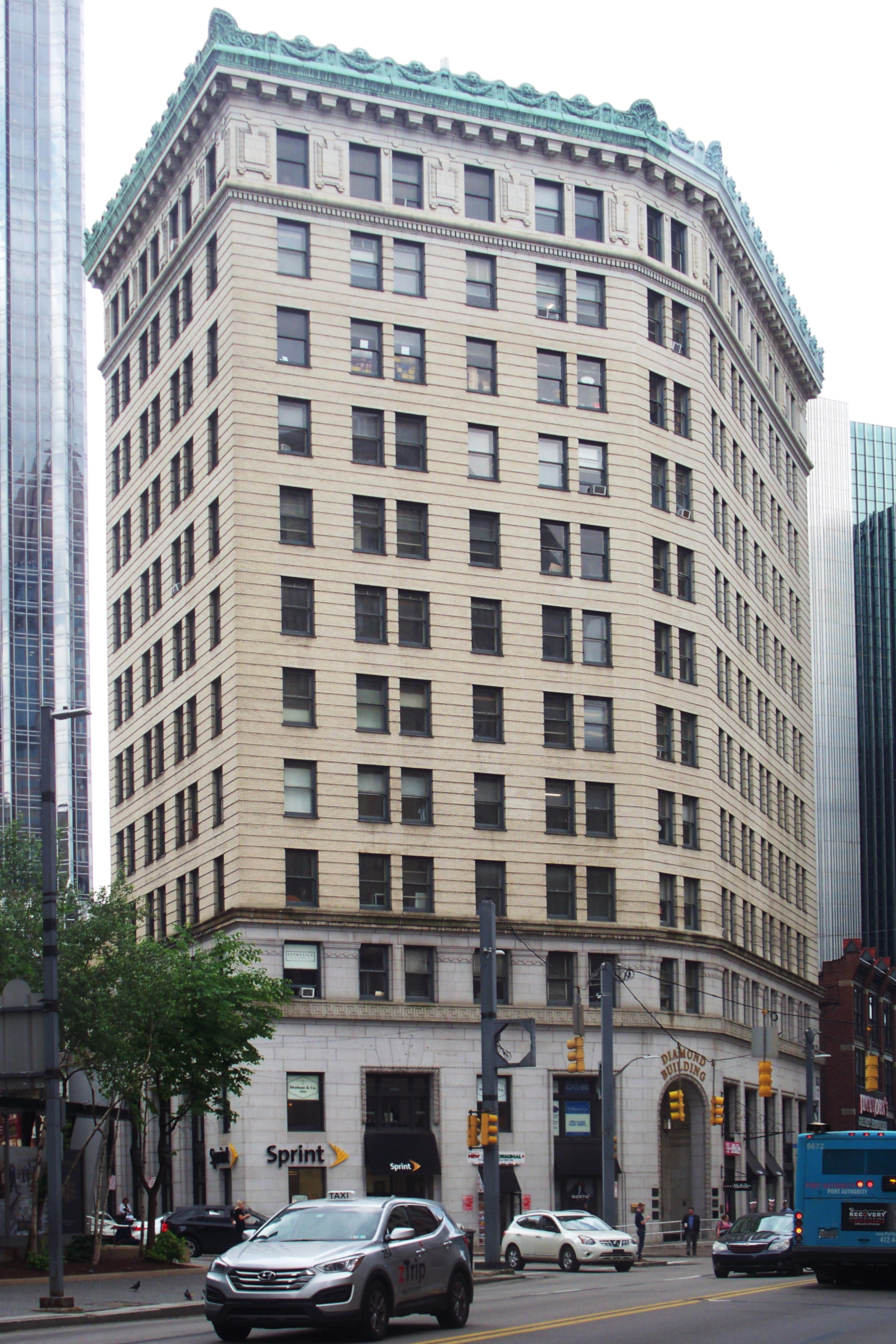
Diamond Building
A partnership of Colbert MacClure and Albert H. Spahr, this firm was responsible for some of our most prominent buildings and some very elegant mansions. They also hired the young architect Benno Janssen, who was destined to contribute even more to our cityscape.
MacClure & Spahr had a national reputation for their millionaires’ mansions, so a number of their largest houses were built outside the Pittsburgh area.
MacClure’s name is also spelled “McClure” in many references, but MacClure seems to be the correct spelling.
Mr. MacClure died in 1912, but Spahr carried on without removing MacClure’s name from the head of the firm.

Union National Bank Building
A profile of Albert H. Spahr from The Brickbuilder, June, 1915, p. 145, gives a short history of the firm.
Albert H. Spahr was born at Dillsburg, Pa., on June 19, 1873. He entered the office of Harry W. Jones, of Minneapolis, in 1889, and after spending five years in this office went to the Massachusetts Institute of Technology in Boston, taking the two-year special course in architecture. In 1896 he spent the summer in England and France. On returning to this country he entered the office of Peabody & Stearns, of Boston, remaining there until 1901 when he went to Pittsburgh and formed a partnership with C. D. MacClure, under the firm name of MacClure & Spahr. Mr. MacClure died in 1912, since which time Mr. Spahr has carried on the business alone.
It seems to be the aim of many young architects to crowd as much architecture as possible in their public or private projects without regard to the feelings of their clients or the public that has to look at their work. They pile orders above each other, and their use of them is so frequent that one often wonders what they would do if Greek frets and Ionic caps were taken from them. We all know the architect that tries to do the Farnese Cornice somewhere up in the clouds, while a column order on the sidewalk darkens the main rooms. Mr. Spahr approaches the subject from a different point of view. Whether in a twenty-story office building or a country house, a set of plans from his office will have every detail studied from the utilitarian as well as the artistic side. Along with a picturesque or monumental treatment of exteriors, the things that count for human comfort and sensible use inside will be carefully thought out. Doors will swing the right way, wall spaces will be left for furniture, light outlets will come where most needed, and radiators slink out of sight. His whole work is marked by a close and particular attention to detail, yet this useful quality does not narrow his conception of architecture as an art, nor does it prevent him giving the full measure of his designing ability to the creation of satisfying architectural compositions as the many large country houses, in which field he has been particularly successful, can testify.
Mr. Spahr is fond of music, as all good architects should be, and when living in Boston often delighted the front rows, from the stage at many of the Cadet performances. In the intervals of absence from smoky Pittsburgh he now leads a nice little family in a dance over his farm in the Berkshire Hills. — F. H. B.

Coraopolis YMCA
Here is a list of some representative buildings by the firm:
640 Pine Avenue, Sewickley (source)
5131 Pembroke Place, Shadyside (with additions by Benno Janssen; source)
1145 Beechwood Boulevard, Point Breeze
1131 Wilkins Avenue, Squirrel Hill
5325 Wilkins Avenue, Squirrel Hill
Eye and Ear Hospital, Soho
Coraopolis YMCA (1010 State Avenue)
Diamond Building
Jones & Laughlin Headquarters Building
Kelly House (207 Beechwood Boulevard)
Keystone Bank Building
Langley High School
Meyer Jonasson & Co. Building
Monongahela Incline lower station (1904; source)
Oliver Bathhouse
Union National Bank Building
Homewood Cemetery entrance buildings
For a longer list, see Father Pitt’s Great Big List of Buildings and Architects.

Oliver Bathhouse
